My goal for this past week was to take the bus to and from the UMD campus 5 times per week
I did not meet my goal this week. I have to say I am not to surprised. I do have busy schedule and that is what did me in. I only took the bus 3 times this past week. I ended up driving because I had other commitments right after class so I did not have the time to take the bus. I had been doing good about not scheduling so tightly so I am kind of disappointed in myself for giving in and taking and driving.
When I did take the bus I felt the same things I have been feeling previously. While I was waiting outside in the cold (and this week seemed really really cold!) I would think of how I could be in my nice warm car. I continued to wake up 10 minutes early so I could easily make the bus and I would not have to rush. It seems over the past few weeks I have gotten into a routine and it really helps me succeed in taking the bus.
I look to continue to strive to take the bus at least 3 times per week to and from campus.
Review of SMART Goal Process:
My SMART goal started off taking the bus 3 times per week and then progressed to taking the bus 5 times per week to and from campus. The amount of times I took the bus gradually increased as I would achieve my goal.
I did not meet my goal the first week because I did not change any of my behaviors. I expected I could just wake up and get on the bus instead of driving. This was not successful. I ended up either rushing and missing the bus or finding out I could not take the bus because I had commitments right after school. Therefore, I started waking up 10 minutes earlier and I started planning other things later in the day so I could have time to take the bus home. This helped my achieving my goals week to week. The weather also helped me be successful. I tend to be afraid of driving in snowy or icy weather. So I had extra incentive on stormy days to take the bus.
I benefited because I am now in a routine that I continue even after the SMART goal project is done. I feel that this is a sustainable action. I also saved a lot of money on gas. I noticed I did not have to fill up my gas tank nearly has often as I did before. It is great!
I learned that taking the bus is not difficult at all. I learned it is also very convenient and it takes about the same amount of time by car and it does by bus. I also learned how to take the bus and how to read a bus schedule. Seems silly but I did not know how to read a bus schedule before. I learned about myself that once I get into a routine it is really easy. The hardest part for me was breaking my old routine, once I got past that it was really easy to change my behavior.
My behavior change benefited the environment because as a result of me taking the bus there was one less car on the road. That is one less car contributing to air and noise pollution. Others benefited from my actions because since I was not driving there was less traffic on the road. If a lot more people took the bus there would be a lot less traffic on the roads.
I do plan on continuing this behavior. I have found it to not be that difficult now that I am in a routine. My recommendation for those seeking a behavior change is to stick with it even if it is difficult at first. The hardest part, in my opinion, is starting the behavior change because it is so different from what you are used to. My advice is to stick with it past that first week. Once you make that initial behavior change, it is all down hill from there!
Blogged for AmyintheRain

Sunday, December 5, 2010

Thursday, December 2, 2010
Advocacy Project:: Letter and Fact Sheet
Letter to representative:
December 6, 2010
Representative Jim Oberstar
House of Representatives
2365 Rayburn HOB
Washington, D.C. 20515
Vote Yes on H.R 3271 Green Routes to Work Act
The proposed act would give tax credits to businesses that provide employees with transit passes or provide commuter vans for employees in order to promote carpooling. With providing both employees and employers with incentives to take mass transit in order to reduce the amount of motor vehicles on the road. This will reduce the amount of both air and noise pollution. As a current health education student from Duluth, Minnesota, I believe the reduction in pollution is extremely important to the health Americans.
The passage of this bill will provide employees with transit passes who otherwise may not consider public transportation. According to the American Public Transportation Association, 18% of an American's income goes towards transportation; transportation is the second largest expenditure of Americans. People who may not see the benefits of public transportation because it costs money will be enticed by free transportation. There are many benefits for people to use public transportation. Primarily it will improve public health. Taking public transportation makes people more active; commuters may have to walk some distance in order to reach a bus stop of their final destination. Those would otherwise be sedentary most of the day are now having exercise in their daily schedule. Public transportation will also decrease air pollution. According the American Public Transportation Association, public transportation prevents the release of 126 million pounds of hydrocarbons per year. The release of hydrocarbons lead to smog and respiratory illness. Finally, with less drivers on the road, the less danger there is. If someone is unfit to drive, whether is be intoxication or distraction, public transportation provides him with a mode of transportation. According to the American Public Transportation Association, distracted drivers cause 284,000 serious motor vehicle accidents each year. Providing tax credits to companies in order for them to provide their employees with transit passes, would provide employees with a safe ride home. With more citizens receiving free transit passes, there will be less traffic which will lead to less pollution and safer roads.
Opponents of this bill may claim it is a waste of money because even though companies may provide transit passes to employees, many employees will continue to drive their personal motor vehicles. When transit passes are offered for free, more are apt to try it. Once employees realize how convenient mass transit is then they are more likely to continue with habit. Also, taking mass transit saves money. Once, employees realize the economical benefits then they will be more inclines to taking mass transit; especially since they are being provided the pass at no cost. Another argument against this bill would be the negative effect it would have on the already struggling car industry. Contrary to theses beliefs, the car industry will not suffer. People will still need cars to drive to places where transit does not run or drive to places after transportation hours. Also, if citizens are saving money of transportation, they will have more expendable cash, therefore stimulating the economy.
Thank you for your time. We appreciate all you have done during your terms of service. As the head of the U.S Department of Transportation, we hope you realize the positive impact the passage of this bill would have on the health and safety of the U.S citizens. We encourage you to vote yes on H.R 3271 Green Routes to Work Act.
Sarah Zapp
Facts Sheet
The Benefits of Public Transportation
According to the American Public Transportation Association (APTA), public transportation provides citizens and communities with ample opportunities.
Mass transits benefits the local community and economy
- A $10 million investment in public transportation has shown to increase buisness in local stores by $30 million.
- According to the Transit Coalition Report: "Dollars & Sense: The Economic Case for Public Transportation in America" states that every dollar consumer puts into public transportation provides a $6 return in the local economy.
- It reduces the amount of money spent of transportation and allows this money to spent on other activities such as recreational or school activities.
- The cost of driving, parking and insuring a car can be steep for some families and deprive some families from other opportunities.
- Regular use of public transportation can save the average consumer $800,000 per every $10 million spent per year.
- Public transportation helps keep senior citizens who want to remain active and apart of the community a mode of transportation.
- 93% of welfare recipients rely on public transportation to get to work and to other destinations.
- According to the Texas Transportation Association, Americans spent more than 40 hours stuck in traffic.
- According to APTA, 50% of Americans feel traffic congestion is a serious problem.
- According to APTA, a person who takes the bus everyday to work in place of driving saves 1,888 gallons of gasoline each year.
- According to APTA, public transportation reduces fuel consumption by 1.5 million gallons each years.
- According to APTA, buses produce 80% less carbon dioxide emissions than any personal motor vehicle.
Monday, November 29, 2010
Reflection Weeks 9-12
In these past 2 weeks I have made some major changes in my life. In week 9 we started our eco-chic lifestyle and have been working on them ever since. I have learned that if I actually put effort towards my goal, it really wasnt that difficult. The biggest challenge for me would prove to be my own laziness. Once I planned ahead I could over come my laziness.
Also, during these past 2 weeks we have been working on our advocacy project. I choose a topic I felt passionately about. We have learned how to contact our congressman in the hopes to persuade them to vote in an environmentally friendly way. I thought it was really cool h0w we could look any bill that was be proposed to congress. I never new that you could do that! We also learned how to write an issue overview, which I thought is a real helpful tool. It really allows you to break down the bill and better understand the issue.
We also started looking more in depth of where our stuff comes from and we were introduced more to our junking projects. We looked more in depth at consumerism. What really shocked me came from the "Story of Stuff" video. I couldn't believe that 99% of the products we buy will not be used 6 months later. I couldn't believe how wasteful our society is. This really affected me when I went shopping for Christmas presents. I am now really careful to buy only quality products that I know for sure will get a lot of use. I am avoiding buying any "filler" gifts. Basically I am no longer buying things just because they are on sale.
I have learned quite a lot these past two weeks and all of this new knowledge this really changing my lifestyle.
Eco-Chic Lifestyle Change Week 4: Weekly Updates
My lifestyle change goal this week was to take the bus to and from the UMD campus 4 times per week.
I once again met my goal! I have ton say I am quite proud of myself. Taking the bus is quite easy and not as inconvenient as I thought it would be. Nothing disastrous has happened yet; I haven't missed my bus or gotten on the wrong bus. All has gone according to plan.
I have continued with my strategies of getting up 10 minutes earlier so I can make my bus on time and I also have been planning ahead so I do not plan anything directly after school. Therefore, I am able to take the bus.
One challenge has been the weather; it is really quite miserable to wait out in the rain. I am always tempted to walk back and get in my nice warm car. One thing I can do to offset this nasty weather is dress properly. I think it maybe time for me to finally break out my winter coat, hats and mittens.
It may sound funny but I am learning how to ride the bus. The first time I rode the bus I didn't know the route at all or even signal how to get off. Luckily the first couple times of taking the bus others had to get off at my stop. I am now becoming more confident when riding the bus. It may sound silly but it is true. One thing I love is how much gas I am actually saving! I haven't had to fill up my gas take in 2 weeks. I can really notice the amount of gas and money that I am saving; it is just fantastic!
My plan for me this week coming week is to take the bus to and from the UMD campus 5 days per week.
This coming week may prove to be a real challenge because I will try not to be tempted to drive to school at all. Hopefully, my schedule isn't to hectic.
Blogged for Amyintherain@blogspot.com
Share and Voice: Question: O' Christmas Tree

With this Thanksgiving done and over with, many people move on to the next coming holiday. In my house, as soon as Thanksgiving was over I helped my mom put up our artificial Christmas tree and when I came back to my apartment I decorated my own artificial tree. This got me thinking, what is better for the environment? My aritifical tree was probably made is a large production plant with all sorts of chemicals. It probably took a lot of gas to ship the tree up to Minnesota from where it was made. Yet, an artificial tree can be used year after year. Is mass farming of Christmas trees any better than mass production of fake ones?
I provided some links about information about artificial vs real Christmas trees:
The Great Debate
National Christmas Tree Association
I ask your opinion:
Do you think an artificial tree or a real tree better for the environment?
Sunday, November 28, 2010
Eye Opener: Photo Essay

TURNING BLACK INTO GREEN:
It is a Thanksgiving tradition for my mother and I to start of Christmas shopping on Black Friday. As we were wondering around at 5am Friday morning, I took pictures of some eco-friendly gift ideas. I also made our shopping trip as green as possible by walking from store to store instead of driving and my mom and I used every reusable bag we could find in our house instead of plastic ones.

 This is basket made of recycled bottle caps.
 This is bag that was crafted from recycled wrappers.
 Barnes & Noble had an adorable selection of school supplies made of recycled material.
 Getting coffee from a Coffee Shop maybe part of a daily ritual for many. A gift idea is reusable coffee cups.
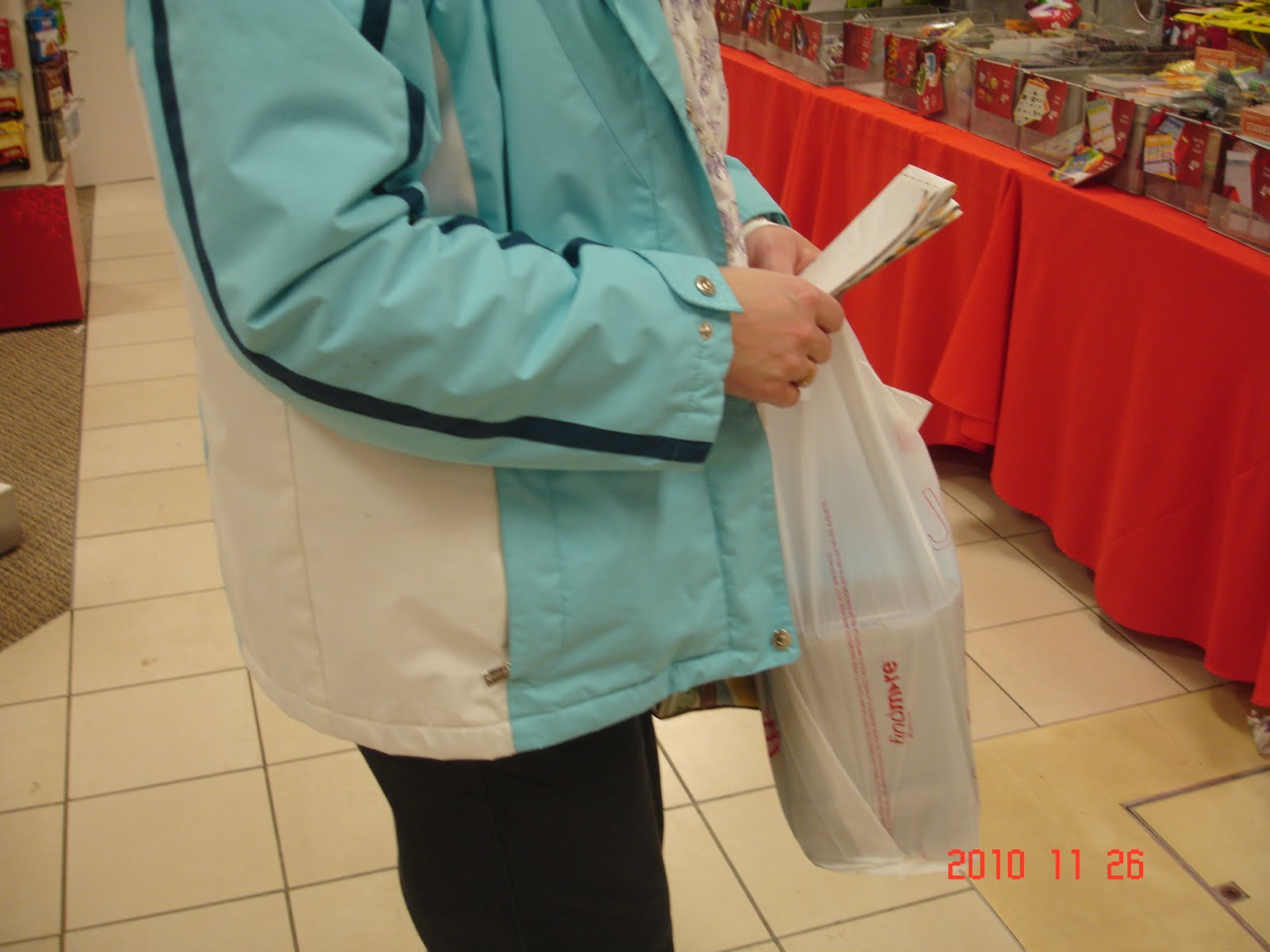 My mom and I had used all of our reusable bags up after a few hours so unfortunately we had to use a few plastic ones.

One of our many reusable bags on Black Friday.
 Another gift idea maybe a reusable water cup or water bottle instead of letting a person buy a bottle of water.
 Finally, one easy a quick way to holiday shopping is buy going online. You still can get good deals on products and you do not have to use gas to drive to the store in hunt of the perfect gift. Also, instead of getting the paper to look at all the ads you can just look them up on the internet and save some paper!
We have been learning a lot about consumerism and how a lot of it is wasteful. This Holiday season I am vowing to buy less and buy higher quality products. Black Friday is notorious for its uber cheap deals on toys, video games, movies, etc. When I was shopping all I could think about was the cost of the products. Who is ACTUALLY paying for me to get this movie for $3.99? I found myself steering clear of products I may have once been attracted to. I focused on what I only really wanted to buy for my friends and family. Hopefully, by paying more attention to what I am buying this holiday season I am contributing less junk to the world.
Tuesday, November 23, 2010
Eco-Chic Lifestyle Change Week 3: Weekly Updates
My SMART Goal was to once again take the bus to and from the UMD campus 3 times per week.
I felt I did much better this week. I actually met my goal! What helped me greatly was planning ahead. I would wake up ten minutes earlier so I wouldn't have to rush to catch the bus and it seemed to work. I also did not have such a busy week, so it was much easier to take the bus because I did not obligations directly after class that I had to rush off to.
Sometimes while I was waiting out in the bitter cold, I would think I could be in my warm car driving right now. It was hard to resist the urge to walk back home and get in my car. Once I was on the bus and a little warmer, I was proud that resisted the temptation because I was one step closer to meeting my goal.
I learned this week, that taking the bus is not that difficult, it is actually quite easy and quite convenient. I was timing my commute and if I count the time it would take for me to walk to my car in the parking lot and then drive home it takes almost the same amount of time to take the bus. I also do not have to deal with headache of parking at UMD. The buses run so often that I do not have to wait to long to catch a bus to and from school. Also, the weather and roads were not to pleasant this past week, so I really enjoyed not having to drive and just taking the bus, It was a lot less stressful!
Blogged for the Eco-Chic Lifestyle Change Week 2 hosted by Amy@Amy in the Rain
Since I completed my goal this week, I am going to up the ante and shoot for taking the bus 4 times per week to and from campus.
Subscribe to:
Posts (Atom)